Guest Post by María Zaballos & MJ Casado
Cybersecurity experts at OmniAccess
The rise of hyper-connected yachts has brought undeniable advantages, from advanced navigation systems to seamless onboard experiences. But with that connectivity comes exposure. Today, cyber threats are not hypothetical. They are real, persistent, and growing in sophistication.
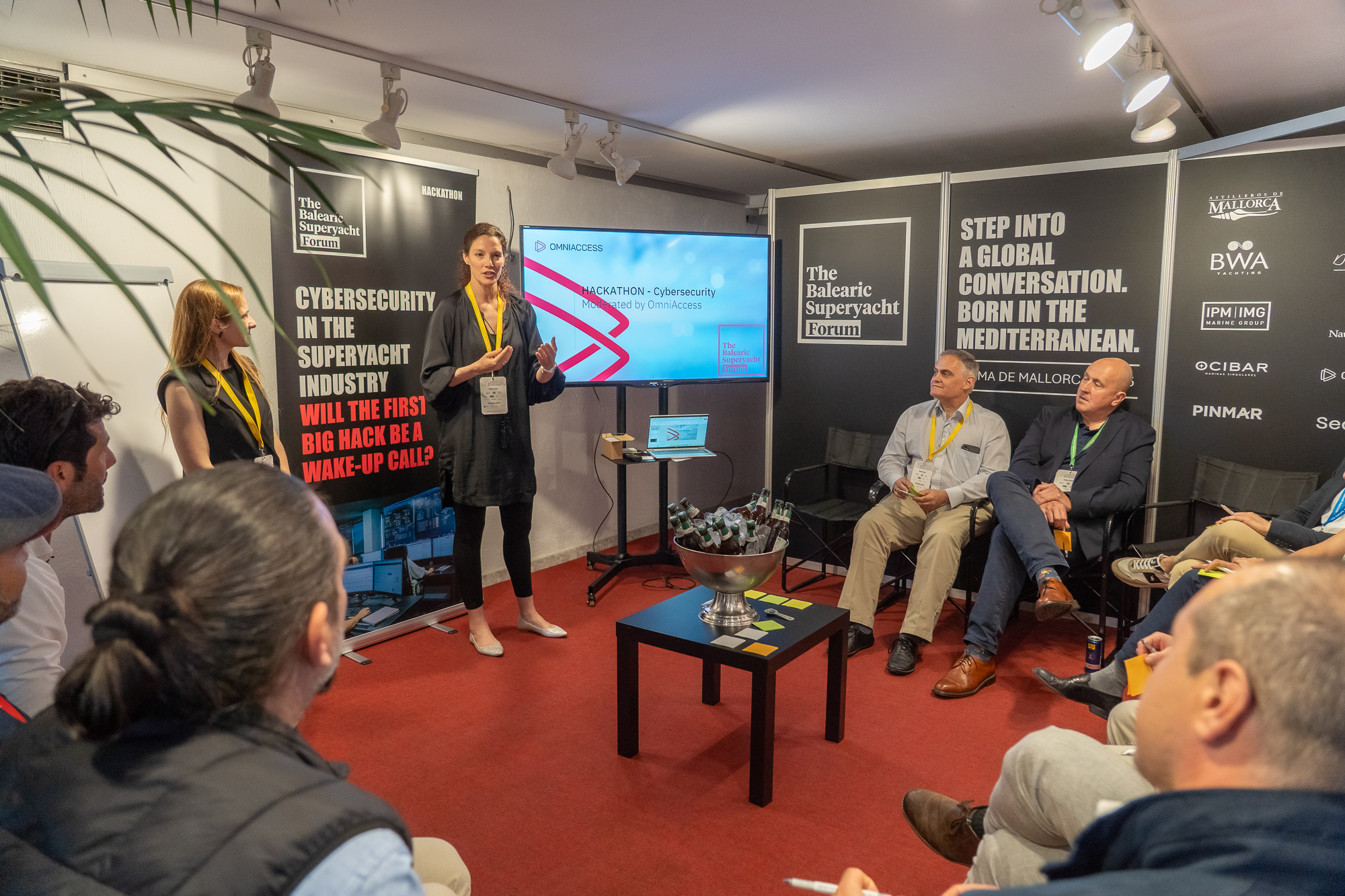
During the Mediterranean Superyacht Forum’s recent webinar, we explored some of the most pressing cybersecurity concerns facing the yachting sector, drawing from our experience in daily operations and the insights gathered during the cybersecurity hackathon at The Balearic Superyacht Forum.
What we’ve tackled regarding cybersecurity in yachting:
- From Hackathon to Reality – The concerns raised during The Balearic Superyacht Forum became the foundation for deeper industry reflection.
- The Threat Landscape – Real-world risks observed through our clients and Security Operations Center, from phishing to OT system vulnerabilities.
- From Strategy to Action – Key cultural and operational shifts required to move from awareness to resilience.
- The Path Forward – Why the industry must stay ahead and how collaboration and proactivity are now non-negotiable.
1. From Hackathon to Reality: The Concerns Are No Longer Theoretical.
In the hackathon, we challenged participants to think like hackers. The result was a long and sobering list of real vulnerabilities—from GPS spoofing and malware threats to unauthorised remote access and the use of personal devices onboard.
The concern that surfaced most clearly? A lack of cybersecurity awareness and education at all levels—crew, vendors, and management. Even with solid hardware in place, basic issues like unchanged passwords, unsecured remote sessions, or poorly segmented networks can become critical entry points for attackers.
2. The Threat Landscape: What We’re Seeing on the Frontlines.
As operators of a dedicated Security Operations Center (SOC) and authors of the 2025 Global Maritime Cyber Threat Report, we continuously track the threat landscape. Five recurring areas stand out:
- Remote Access Mismanagement – Open or weakly secured vendor connections are among the top vulnerabilities we encounter. Without oversight, they offer direct pathways into critical systems.
- Phishing & Social Engineering – Despite being an old tactic, phishing remains alarmingly effective. Poor training and a lack of verification protocols leave many yachts exposed.
- Outdated Technology & Lack of Visibility – Many vessels lack a clear asset inventory. It’s impossible to protect what you don’t know exists, and even harder to defend legacy systems no longer fit for today’s threats.
- Insufficient Segmentation – When IT and OT systems share the same network, a breach can escalate rapidly. The absence of proper VLANs or isolated guest networks is more common than it should be.
- OT Security Gaps – As yachts become more reliant on automation and interconnected systems, the potential for disruption—from propulsion control to HVAC sabotage—is no longer limited to fiction.
3. From Strategy to Action: What Needs to Change.
While the threats are increasingly complex, many of the most effective cybersecurity measures remain surprisingly straightforward. The challenge lies not in the lack of solutions, but in the lack of consistent implementation and prioritisation across the industry. To move from awareness to resilience, several key shifts are needed:
- Education is not optional – Cybersecurity begins with people. Regular training for crew and technical teams—paired with phishing simulations and drills—builds the reflexes needed to detect and respond to real threats. Education should go beyond one-off sessions and become a structured, ongoing programme onboard and onshore.
- Monitoring matters – Having systems in place is not enough if there’s no visibility into how they perform. Security Operations Centers (SOCs), logging tools, and alerting systems allow vessels to detect anomalies in real time, track access sessions, and react before minor incidents escalate. Monitoring gives context, and context enables control.
- Policies must become culture – Written procedures without enforcement are meaningless. Password hygiene, access control, software update protocols, and incident response plans must become embedded into the day-to-day operations of vessels, not just formalities reviewed during audits.
- Remote access must be redefined – The current model—where external vendors often retain unchecked, open access—must evolve. Privileged Remote Access (PRA) solutions shift control back to the vessel, enabling session recording, access limitation, and auditability. Only necessary access should be granted, and only for as long as it’s needed.
- Collaboration is key – No stakeholder can address these challenges alone. Shipyards, captains, managers, ETOs, IT vendors, and classification societies must align around shared standards and expectations. Cross-functional collaboration is what turns fragmented actions into systemic change.
- Proactivity beats reactivity – The industry must transition from “protecting when something happens” to anticipating. That means regular risk assessments, penetration testing, asset inventories, and structured gap analysis based on standards like ISO 27001 or IACS UR E26/E27. Waiting for an attack is no longer a defensible strategy.
4. The Path Forward.
Cybersecurity is not a one-time fix—it’s a continuous process. In an industry where safety, privacy and reputation are non-negotiable, staying ahead means integrating cybersecurity into every layer of yacht operations.
We’re grateful to the Mediterranean Superyacht Forum for creating a space to keep these conversations alive. As the claim says, this is “a new collaborative way to drive the future of yachting,” and cybersecurity must be part of that future.
Let’s not wait for a crisis to act. Let’s stay ahead, together.
Want to dive deeper into the topic?
If you missed the live session or would like to revisit the discussion in full, we invite you to watch the recording of the webinar and explore the insights shared by the OmniAccess team.
ABOUT THE AUTHORS

María Zaballos
Cybersecurity & Solutions Specialist, OmniAccess
Bringing hands-on experience in designing and implementing onboard cyber protection systems.

MJ Casado
Head of Cyber & Security Intelligence, OmniAccess
An industry leader in threat intelligence and digital risk management for maritime environments.